- Ambition and Survival (essays by Christian Wiman)
- Embryoyo (poems by Dean Young)
- Halflife (poems by Meghan O'Rourke)
- Donkey Gospel (poems by Tony Hoagland)
Showing posts with label Recommended Reading. Show all posts
Showing posts with label Recommended Reading. Show all posts
Monday, September 24, 2007
Books!
Running perilously low on reading material ("perilously" because of the way an hour or so of reading kicks off my writing day, every day), I went searching this weekend and returned with some great stuff. I've found that the work of a few poets in particular resonates with the new kind of poems I'm writing now. For the most part they're poets I've always liked, but now I'm seeing something new in them. People like Kay Ryan, Kenneth Koch, August Kleinzahler, Billy Collins, Tony Hoagland, Dean Young, Ruth Stone, Kevin Young, etc. Very exciting. Anyway, here's what I brought home this weekend:


Friday, September 07, 2007
Restrain Yourselves
This morning I re-read W.D. Snodgrass' masterful essay on poetry, "Tact and the Poet's Force," which he wrote just under half a century ago (and which is included in a book I've raved about before, Claims for Poetry). In it, he states that, "it is a poet's business to say something interesting.... He always says something we have not heard before; he always suggests possibilities," and explores the three ways poets create something "worth stopping for":
- Through a new idea
- Through new details or facts within old ideas
- Through a new style
Wednesday, July 25, 2007
Real Sofistikated
 It's been a while since I've raved about a particular book, but Tony Hoagland's essay collection Real Sofistikashun deserves a few cheers. In it he does an exceptionally good job representing a centrist perspective on poetry, keenly assessing contemporary trends while modestly advocating for poems that resonate with human experience. His essay "Fear of Narrative and the Skittery Poem of Our Moment" contains one of the most insightful and balanced explanations for the tendency of contemporary poets to reject meaning and narrative that I've read yet -- as well as a persuasive argument for poets to be cautious in following that impulse:
"One can understand how disassociative poetry has become fashionable, celebrated, taught, and learned--it is a poetry equal, in its velocity, to the speed and disruptions of contemporary culture. It responds to the postmodern situation with a joyful crookedness. And one can also see why poetics that assert sensible order (which, admittedly, can be predictable and reductive) have fallen a bit from fashion: after all, the pretense of order is, in some way, laughable. Art has to play, it has to break rules, to turn against its obligations, to be irresponsible, to recast convention. Some wildness is essential to its freedom. Yet every style has its shadowy limitation, its blind eye, its narcissistic cul-de-sac. There is a moment when a charming enactment of disorientation becomes an homage to dissociation. And there is a moment when the poetic pleasure of elusiveness, inadvertently, commits itself to triviality."Hear, hear! If you're looking for a smart, humble exploration of American poetry today, check out this book.
Thursday, July 12, 2007
Funny Peculiar
Poets often get caricatured as humorless, brooding party-spoilers. So I was happy to see that Poetry magazine used its summer issue to bash away at that image like a dark piñata and scoop up all the hard candy hidden inside. Ah, piñatas. Blind rage and destruction rewarded with sugar -- what's not to like?
In addition to some vivacious poems, the July/August issue features several very funny essays by writers like Nareem Murr, on living with a poet ("The secret to a poet's soul lies somewhere in the little cells of that dungeonish dictionary, in the slow languishing of those old, mad, forgotten words. It's also in the very particular kind of art she -- and every poet -- seems to love. Joseph Cornell. I guarantee you will not find a single poet who doesn't start rubbing herself against the furniture the minute you mention Cornell and his little boxes full of human residue, the pleasures of the miniature."); and Michael Lewis, who imagines poetry infecting the New York Giants ("11/13... Apparently Eli [Manning] told Coach that he no longer trusts our offensive coordinator, John Hufnagel. He claims that he wrote his first villanelle, but Hufnagel just sneered and called it 'an inferior form, for poets who've run out of things to say.' Eli said that if the Giants couldn't create 'a safe space,' he wanted to be traded to a team that could.").
Funny ha-ha, funny peculiar, a little of both. Pick up a copy before your flight out of town.
In addition to some vivacious poems, the July/August issue features several very funny essays by writers like Nareem Murr, on living with a poet ("The secret to a poet's soul lies somewhere in the little cells of that dungeonish dictionary, in the slow languishing of those old, mad, forgotten words. It's also in the very particular kind of art she -- and every poet -- seems to love. Joseph Cornell. I guarantee you will not find a single poet who doesn't start rubbing herself against the furniture the minute you mention Cornell and his little boxes full of human residue, the pleasures of the miniature."); and Michael Lewis, who imagines poetry infecting the New York Giants ("11/13... Apparently Eli [Manning] told Coach that he no longer trusts our offensive coordinator, John Hufnagel. He claims that he wrote his first villanelle, but Hufnagel just sneered and called it 'an inferior form, for poets who've run out of things to say.' Eli said that if the Giants couldn't create 'a safe space,' he wanted to be traded to a team that could.").
Funny ha-ha, funny peculiar, a little of both. Pick up a copy before your flight out of town.
Monday, July 02, 2007
Reading List Update
With a workweek chock full of deadlines behind me, I'm looking forward to some more restful and productive writing time in the week ahead. I'm also making progress on my reading list and thought I'd share what I've read so far. Here's what's done and on the shelf:
Poetry
Poetics
Poetry
- Bogan, Louise. The Blue Estuaries
- Fennelly, Beth Ann. Open House
- Goldbarth, Albert. The Kitchen Sink: New and Selected Poems 1972-2007
- Heaney, Seamus. District and Circle
- Homer, The Illiad (trans. Robert Fagles)
- Hopler, Jay. Green Squall
- Keats, John. The Major Works (Poems and Selected Letters)
- Mehigan, Joshua. The Optimist
- Oliver, Mary. Thirst
- Phillips, Carl. Riding Westward
- Rilke, Rainer Maria. Duino Elegies and the Sonnets to Orpheus (A. Poulin Jr. trans.)
- Sandburg, Carl. Complete Poems
- Strand, Mark. Man and Camel
- Whitman, Walt. Laws for Creations (ed. Michael Cunningham)
- Wojahn, David. Interrogation Palace
- Young, Kevin. For the Confederate Dead
Poetics
- Gioia et. al. Twentieth Century American Poetics
- Hall, Donald. Breakfast Any Time All Day
- Packard, William. The Art of Poetry Writing
- Simic, Charles. Orphan Factory
Wednesday, May 30, 2007
Kevin Young Kicks Ass
And really, that's about all I have to say. I've mentioned previously that I frequently turn to his book Jelly Roll for inspiration. His poems are witty, musical and seemingly effortless, all at once. Now I'm reading his latest collection of poems, For the Confederate Dead, and enjoying it mightily. Here's a fragment for you, from his poem "Bedlam":
And by the way, as someone who appreciates books as objects as well, let me add that designer Gabriele Wilson at Knopf has done beautiful work for Young's books. Ms. Wilson's cover designs have been praised by many others but I gladly add my name to that list. In the publishing version of fantasy football, she'd be my designer and Graywolf my publisher. Well, I can dream, can't I?
"No such thingGood stuff. Go buy it!
as sleep--just the noise
of night, cars kicking
up country roads--
even the silence
shouts. No one raises
glasses or hell--
just kids, well-
behaved, who walk
home old ladies
refusing tips.
No thanks. What
are we coming to?..."
And by the way, as someone who appreciates books as objects as well, let me add that designer Gabriele Wilson at Knopf has done beautiful work for Young's books. Ms. Wilson's cover designs have been praised by many others but I gladly add my name to that list. In the publishing version of fantasy football, she'd be my designer and Graywolf my publisher. Well, I can dream, can't I?
Wednesday, May 16, 2007
Reading Keats, Considering Comix
I'm reading Keats' poems and selected letters at the moment, both of which have proved inspiring except for when I recall how much he was able to accomplish in so little time. Then it's almost overwhelmingly humbling. The contradictory responses I have when reading this kind of poetry are alarming in their extremity; one part of me clamors to write poems that are just as good while another asks why even bother trying? Fortunately (for me, if no one else) the clamor usually prevails. "Try again. Fail again. Fail better," right?
On an entirely different note, I've also been considering what form a new kind of poetry, befitting a culture of assemblages, collage and remixes, might take. I've envisioned something that draws on and adds to the shape and force of other writers' work: the poem as symbiont, perhaps literally attached to its host. I think of the telescoping tangents and intricacies of Chris Ware's graphic novels. Words inspiring additional reflection or reaction. The poem as a small system of planets orbiting a central star. Well, it sounds interesting in theory. I'll let you know how things turn out in practice.
On an entirely different note, I've also been considering what form a new kind of poetry, befitting a culture of assemblages, collage and remixes, might take. I've envisioned something that draws on and adds to the shape and force of other writers' work: the poem as symbiont, perhaps literally attached to its host. I think of the telescoping tangents and intricacies of Chris Ware's graphic novels. Words inspiring additional reflection or reaction. The poem as a small system of planets orbiting a central star. Well, it sounds interesting in theory. I'll let you know how things turn out in practice.
Monday, March 26, 2007
Just an Update
Still working on defining my own guiding principles for poetry, and of course on continued revisions. I hope this week proves to be more productive than last, though a business trip on Thursday / Friday threatens to foul things up a bit. Airport poem, anyone?
I'm also looking toward my next submission, with the hope of getting another one out before April. Given that this week may be a little frantic, that will probably happen over the weekend instead. I've found that using the weekends to prepare submissions and do research (e.g., additions to my reading list, literary magazines, poetry events) is a good way to keep up my momentum while also giving myself a break. It also allows me more time during the week to devote to the poems themselves.
 Speaking of reading, Fagles' translation of The Iliad has been incredible. At the end of Book 6, which I just completed this morning, there is a lovely and agonizing moment when Hector, having briefly returned from the battlefield to visit his wife and infant son, prepares to leave them again. Despite his assurances, his wife Andromache fears he will be killed. As Hector reaches down to touch his son--possibly for the last time--the boy cries out and recoils, afraid of his father's helmet and armor. It's an unexpectedly bittersweet and human moment in an epic that otherwise occupies itself largely with armies, heroes and gods, and it's the kind of moment to which I think poets ought to gravitate.
I'm also looking toward my next submission, with the hope of getting another one out before April. Given that this week may be a little frantic, that will probably happen over the weekend instead. I've found that using the weekends to prepare submissions and do research (e.g., additions to my reading list, literary magazines, poetry events) is a good way to keep up my momentum while also giving myself a break. It also allows me more time during the week to devote to the poems themselves.
 Speaking of reading, Fagles' translation of The Iliad has been incredible. At the end of Book 6, which I just completed this morning, there is a lovely and agonizing moment when Hector, having briefly returned from the battlefield to visit his wife and infant son, prepares to leave them again. Despite his assurances, his wife Andromache fears he will be killed. As Hector reaches down to touch his son--possibly for the last time--the boy cries out and recoils, afraid of his father's helmet and armor. It's an unexpectedly bittersweet and human moment in an epic that otherwise occupies itself largely with armies, heroes and gods, and it's the kind of moment to which I think poets ought to gravitate.
Wednesday, March 14, 2007
Revisions and Confusions
More revisions today as I try to prepare another set of poems for sending out. A mix of older and newer drafts, this time. This week I've been enjoying looking back on some of the poems I did five or six years ago and allowing myself to edit them aggressively. The intervening years provide the necessary distance to be merciless with those cherished lines and images.
Meanwhile, Gioia, Mason and Schoerke's Twentieth-Century American Poetics has been excellent so far, though I'm only a few poets in. This morning I read Robinson Jeffers' "Poetry, Gongorism and a Thousand Years," which was published in 1948 but retains much of its relevancy. In it he describes the intentions and methods of a hypothetical "great poet." Among the passages I find striking:
Meanwhile, Gioia, Mason and Schoerke's Twentieth-Century American Poetics has been excellent so far, though I'm only a few poets in. This morning I read Robinson Jeffers' "Poetry, Gongorism and a Thousand Years," which was published in 1948 but retains much of its relevancy. In it he describes the intentions and methods of a hypothetical "great poet." Among the passages I find striking:
"... to put the matter more fundamentally, I believe that our man would turn away from the self-consciousness and naive learnedness, the undergraduate irony, unnatural metaphors, hiatuses and labored obscurity that are too prevalent in contemporary verse. His poetry would be natural and direct. He would have something new and important to say, and just for that reason he would wish to say it clearly. He would be seeking to express the spirit of his time (as well as all times), but it is not necessary, because an epoch is confused, that its poet should share its confusions."
Monday, March 12, 2007
David Orr: Drawn to Heat and Conflict
Whether you agree or disagree with John Barr's tract on The State of Poetry Today (which, however rickety it may have first appeared, increasingly seems to have achieved near-earth orbit alongside similarly shouted-about essays like Dana Gioia's "Can Poetry Matter?"), you have to give him credit for igniting a large and lively discussion.
David Orr, resident poetry critic for The New York Times, is the latest to weigh in, with an essay in yesterday's paper ("Annals of Poetry") that assesses Dana Goodyear's assessment of the brouhaha. Orr is kind of like the Predator of the poetry community, attracted to areas of conflict where he can prowl among the combatants and maybe do a little hunting of his own. A few years ago, for example, he wittily chronicled August Kleinzahler's attack on Garrison Keillor's anthology Good Poems. He is also known for very neatly skewering Jorie Graham.
In this latest piece, Orr questions Goodyear's article and calls The New Yorker to task for pimping poems for the sake of its literary reputation in the magazine market. I personally am glad that The New Yorker continues to print poetry, but I agree with Orr's point that its efforts to straddle several different readerships means that it sometimes makes questionable decisions about what it purveys ("bad poems by excellent poets," he says).
More to the point, I agree with his moderate take on Barr's essay and the Poetry Foundation's efforts to coax American poetry out of its cloister. It captures my own views better than anything else I've read yet.
David Orr, resident poetry critic for The New York Times, is the latest to weigh in, with an essay in yesterday's paper ("Annals of Poetry") that assesses Dana Goodyear's assessment of the brouhaha. Orr is kind of like the Predator of the poetry community, attracted to areas of conflict where he can prowl among the combatants and maybe do a little hunting of his own. A few years ago, for example, he wittily chronicled August Kleinzahler's attack on Garrison Keillor's anthology Good Poems. He is also known for very neatly skewering Jorie Graham.
In this latest piece, Orr questions Goodyear's article and calls The New Yorker to task for pimping poems for the sake of its literary reputation in the magazine market. I personally am glad that The New Yorker continues to print poetry, but I agree with Orr's point that its efforts to straddle several different readerships means that it sometimes makes questionable decisions about what it purveys ("bad poems by excellent poets," he says).
More to the point, I agree with his moderate take on Barr's essay and the Poetry Foundation's efforts to coax American poetry out of its cloister. It captures my own views better than anything else I've read yet.
Friday, February 23, 2007
A Workshop Poem
William Packard, who taught creative writing in New York for more than 40 years, has a cutting section on workshops in his curmudgeonly, old-school tome The Art of Poetry Writing. I couldn't resist reprinting a poem by Norman Stock that he finds illustrative of their faults:
Stafford's book, by the way, is better than most so-you-want-to-be-a-poet books. He's straightforward, if distant, and he takes a back to basics approach that emphasizes reading and discipline. He's not politically correct, he's not comprehensive, and he has a decidedly Western focus, but his determined attention to the fundamentals sets him apart.
Thank You forSad but true. And hilarious.
the Helpful Comments
I sit quietly listening
as they tear my poem to shreds in the poetry workshop
as each one says they have a "problem" with this lineand they have a "problem" with that lineand I am not allowed to speak because that is the
etiquette of the workshop
so I sit listening and writing while they tear the
guts out of my poem and leave it lying bleeding and dead
and when they're finally finished having kicked the
stuffing out of it
having trimmed it down from twenty lines to about four
words that nobody objects to
then they turn to me politely and they say well Norman
do you have any response
response I say picking myself up off the floor and
brushing away the dirt while holding on for dear
life to what I thought was my immortal poem now
dwindled to nothing
and though what I really want to say is can I get my
money back for this stupid workshop what I say
instead is... uh... thank you for your helpful
comments... while I mumble under my breath
motherfuckers wait till I get to your poems
Stafford's book, by the way, is better than most so-you-want-to-be-a-poet books. He's straightforward, if distant, and he takes a back to basics approach that emphasizes reading and discipline. He's not politically correct, he's not comprehensive, and he has a decidedly Western focus, but his determined attention to the fundamentals sets him apart.
Wednesday, February 14, 2007
Big Red Hearts
 Valentine's Day, which of course is one of the few days when poets actually seem useful. Good love poems are hard to write. I'm working on a couple right now, and since I am, and since it's a love-hungry day, I thought I'd mention Isn't It Romantic: 100 Love Poems by Younger American Poets, an especially good collection that Verse Press (now Wave Books) published in 2004. Here's a sample from poet G.E. Patterson, characteristically quiet and careful (for him, I mean -- others in this anthology are not so quiet):
"The Saint's First Wife Said"Other great poets included are the likes of Nick Flynn, Peter Gizzi, Lisa Jarnot, D.A. Powell, Terrance Hayes, Rebecca Wolff, Kevin Young, etc. All around a nice grouping. Plus (but wait, there's more!) it's accompanied by a CD of love songs by various indie rock all-stars and others.
I woke to your face not looking at me
but at the bird that settled on your wrist,
lured by food. Its trust, for once, was rewarded.
You offered the bird everything you had.
I remember. That is how it began
with us: You held out your hand; I took it.
Friday, February 02, 2007
Mind the Gap
Next week AWY will endure a short hiatus while I enjoy a long-planned vacation in Jamaica. In my experience, poems written during such trips tend to resemble the palm tree-busy art you bring back to hang in your living room; what seemed stunningly beautiful there just looks embarrassingly out of place here. Nonetheless, between Red Stripes I intend to do at least a little writing to keep up my momentum. I swear I will keep the mango, rasta and reef references subtle. Mega-resorts and tourists are totally fair game, though I hope to avoid both as much as possible.
Those of you who are Chicagoans and need a lit fix in AWY's absence would do well to check out Kim Addonizio's pre-Valentine's Day reading next week. I haven't read much of her newer work, but I'm a fan of her violent and lovely 2000 collection Tell Me. Details are below.
DATE: Thursday, February 8
TIME: 7 PM
PLACE: The HotHouse (31 East Balbo Ave.)
COST: Free
Those of you who are Chicagoans and need a lit fix in AWY's absence would do well to check out Kim Addonizio's pre-Valentine's Day reading next week. I haven't read much of her newer work, but I'm a fan of her violent and lovely 2000 collection Tell Me. Details are below.
DATE: Thursday, February 8
TIME: 7 PM
PLACE: The HotHouse (31 East Balbo Ave.)
COST: Free
Tuesday, January 23, 2007
Travels with Carl
Some observant AWY readers will have noticed that Carl Sandburg's Complete Poems has been in my reading pile for some time now. That will continue to be the case as I make my way through his 600+ page work at the pace of about 10-15 pages a day. As one of the most recognized poets of Chicago (really, the poet of Chicago), I thought he would make a good companion as I started off.
So far he's proven an able guide. Before I began reading him in earnest, I knew him only for "city of broad shoulders" -type sentiments. But he's been good company not only because of his obvious affection for the city of Chicago and its people (and in particular, its workers), but because of the humor, pathos and sheer strangeness of so many of his poems. He is democratic in all senses of the word. Back then, he was a poet of hogs, bricklayers, harbors, blood, money, jazz, boxcars, Lake Michigan, jabberers, plagues, honeycomb, beautiful women, Jesus, and the blues. If he were writing now I think he would gravitate toward much of the same, plus pay-day loans, do-rags, express buses, broasted chicken, Beamers, green cards, pawnshops, lawyers, towncars, junkies and labradoodles.
Of course, Sandburg is also a poet of two world wars, and the frustration, sorrow and fury of his poems over the suffering and death of the people he feels so much for is, in our own time of far more senseless conflict, somehow comforting but deeply sad. It reminds me what's worth writing about, and how hard it is to get it right.
So far he's proven an able guide. Before I began reading him in earnest, I knew him only for "city of broad shoulders" -type sentiments. But he's been good company not only because of his obvious affection for the city of Chicago and its people (and in particular, its workers), but because of the humor, pathos and sheer strangeness of so many of his poems. He is democratic in all senses of the word. Back then, he was a poet of hogs, bricklayers, harbors, blood, money, jazz, boxcars, Lake Michigan, jabberers, plagues, honeycomb, beautiful women, Jesus, and the blues. If he were writing now I think he would gravitate toward much of the same, plus pay-day loans, do-rags, express buses, broasted chicken, Beamers, green cards, pawnshops, lawyers, towncars, junkies and labradoodles.
Of course, Sandburg is also a poet of two world wars, and the frustration, sorrow and fury of his poems over the suffering and death of the people he feels so much for is, in our own time of far more senseless conflict, somehow comforting but deeply sad. It reminds me what's worth writing about, and how hard it is to get it right.
Thursday, January 18, 2007
Quotes on Ambition
I've just finished Donald Hall's collection of essays on poetry, Breakfast Served Any Time All Day, and his essay "Poetry and Ambition" seems to be resonating with me. A few quotes I find especially memorable:
"I see no reason to spend your life writing poems unless your goal is to write great poems."
"Poets who stay outside the circle of peers--like Whitman, who did not go to Harvard; like Dickinson for whom there was no tradition; like Robert Frost, who dropped out of two colleges to make his own way--these poets take Homer as their peer. To quote Frost again: 'The thing is to write better and better poems. Setting our heart when we're too young on getting our poems appreciated lands us in the politics of poetry which is death.'"
"Although in theory workshops serve a useful purpose in gathering young artists together, workshop practices enforce the McPoem. This is your contrary assignment: Be as good a poet as George Herbert. Take as long as you wish."
"If it seems hopeless, one has only to look up in perfect silence at the stars... and it does help to remember that poems are the stars, not poets. Of most help is to remember that it is possible for people to take hold of themselves and become better by thinking. It is also necessary, alas, to continue to take hold of ourselves -- if we are to pursue the true ambition of poetry. Our disinterest must discover that last week's nobility was really covert rottenness, et cetera. One is never free and clear; one must work continually to sustain, to recover."
"I see no reason to spend your life writing poems unless your goal is to write great poems."
"Poets who stay outside the circle of peers--like Whitman, who did not go to Harvard; like Dickinson for whom there was no tradition; like Robert Frost, who dropped out of two colleges to make his own way--these poets take Homer as their peer. To quote Frost again: 'The thing is to write better and better poems. Setting our heart when we're too young on getting our poems appreciated lands us in the politics of poetry which is death.'"
"Although in theory workshops serve a useful purpose in gathering young artists together, workshop practices enforce the McPoem. This is your contrary assignment: Be as good a poet as George Herbert. Take as long as you wish."
"If it seems hopeless, one has only to look up in perfect silence at the stars... and it does help to remember that poems are the stars, not poets. Of most help is to remember that it is possible for people to take hold of themselves and become better by thinking. It is also necessary, alas, to continue to take hold of ourselves -- if we are to pursue the true ambition of poetry. Our disinterest must discover that last week's nobility was really covert rottenness, et cetera. One is never free and clear; one must work continually to sustain, to recover."
Tuesday, January 09, 2007
Kevin Young Reading - January 16
Strange goings-on. This morning, battling writers block, I turn to Kevin Young's incredible collection Jelly Roll for inspiration. Hours later, I get an email announcement that he will be reading from his newest book, For the Confederate Dead, next week. And there was much rejoicing.
Those in Chicago will not want to miss this chance to see one of the best young American poets working today. Here are the details:
DATE: Tuesday, January 16
TIME: 6 PM
PLACE: The Newberry Library (60 West Walton St.)
COST: Free, but reservations required - call (312) 787-7070
Those in Chicago will not want to miss this chance to see one of the best young American poets working today. Here are the details:
DATE: Tuesday, January 16
TIME: 6 PM
PLACE: The Newberry Library (60 West Walton St.)
COST: Free, but reservations required - call (312) 787-7070
Friday, December 15, 2006
A Closer Look at First Books
This morning I finished re-reading Seamus Heaney's Death of a Naturalist, one of my favorite collections of his work. It's also the first book he published, at the age of 27. Given that my goal for the year is to ready a manuscript for publication, it occurred to me that I should take a closer look at other first books by poets I like to see how they pulled it off. If you have suggestions for particularly remarkable ones, let me know.
In the meantime, I will try to avoid thinking too much about the fact that Heaney wrote Death of a Naturalist when he was 27. On the one hand, very inspiring. On the other, hugely depressing.
In the meantime, I will try to avoid thinking too much about the fact that Heaney wrote Death of a Naturalist when he was 27. On the one hand, very inspiring. On the other, hugely depressing.
Friday, October 27, 2006
Practical Poetics
Over the last few years, I've become addicted to reading poets' accounts of the more quotidian side of writing -- how they got started, what they do when they get up in the morning, where they find inspiration, how they avoid bankruptcy, etc. I find these essays uniquely inspiring, perhaps mostly because they show that Charles Simic or Donald Hall or Galway Kinnell struggle (or once did) with some of the same challenges I do. I look to them for tips on self-discipline and survival. Those that focus on craft also make a good substitute for a writing class in a pinch.
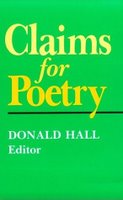 Props to The University of Michigan Press for almost single-handedly propelling this genre through its Poets on Poetry series, for which Donald Hall and David Lehman serve as editors. It includes dozens of books on writing by just about every major American poet. Especially noteworthy is Donald Hall's Claims for Poetry (originally published in 1982), an anthology of some of the best essays on poetics I've read yet. The essay that starts it off, A.R. Ammons' "A Poem Is a Walk," shifted my entire perspective on writing. If I were going to teach a class on writing poetry, I think Claims for Poetry would be the only required reading beyond actual poems.
Plus, who could resist that retro green cover? The stick-on font? The two-tone urine-yellow lettering? The dorkiness is so overwhelming it's transcendent.
Anyway, more Poets on Poetry books will surely be on my own reading list for the coming year. If you have other recommendations, let me know.
 Props to The University of Michigan Press for almost single-handedly propelling this genre through its Poets on Poetry series, for which Donald Hall and David Lehman serve as editors. It includes dozens of books on writing by just about every major American poet. Especially noteworthy is Donald Hall's Claims for Poetry (originally published in 1982), an anthology of some of the best essays on poetics I've read yet. The essay that starts it off, A.R. Ammons' "A Poem Is a Walk," shifted my entire perspective on writing. If I were going to teach a class on writing poetry, I think Claims for Poetry would be the only required reading beyond actual poems.
Plus, who could resist that retro green cover? The stick-on font? The two-tone urine-yellow lettering? The dorkiness is so overwhelming it's transcendent.
Anyway, more Poets on Poetry books will surely be on my own reading list for the coming year. If you have other recommendations, let me know.
Subscribe to:
Posts (Atom)